

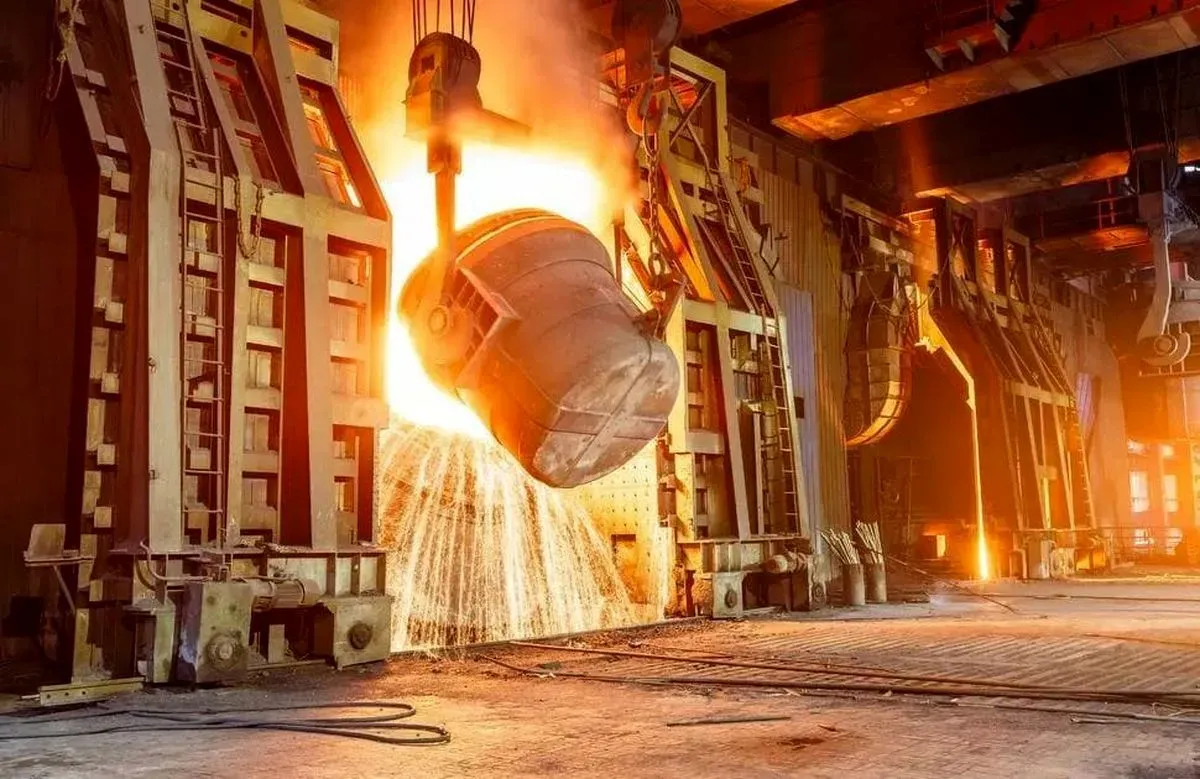
Following the attack on the country’s industrial infrastructure, parts of Khuzestan Steel, including Reduction Unit 2, the Zamzam 3 megamodule and steelmaking facilities, were damaged and production lines temporarily stopped. As emergency teams attended and contained the incident, experts began assessing damage and preparing to restart production. Given the large share of national steel output accounted for by Khuzestan Steel and Mobarakeh Steel, the event could affect production and exports in this strategic industry.
Steel infrastructure is a vital pillar of any country’s economy. As a powerful arm of Iran’s non-oil trade, the industry helps meet domestic and export requirements. Recent American–Zionist enemy attacks on Khuzestan Steel and Mobarakeh Steel have nevertheless heightened concerns about infrastructure security and industrial stability. Such attacks damage production lines and can directly affect the national economy and society’s essential needs.
Reports indicate that Reduction Plant 2 and the Zamzam 3 megamodule sustained severe damage, suspending production. Firefighting and rescue teams were dispatched to stabilise conditions. Experts then assessed the situation, estimated losses and planned the reconstruction of production lines.
Khuzestan Steel and Mobarakeh Steel, with annual capacity representing 50% of the country’s steel production, underpin many dependent industries. Any interruption can therefore have broad national consequences. Annual steel production reaches 32 million tonnes, of which 22 million tonnes serve domestic demand and 10 million tonnes are exported. Damage to production units could reduce exports and harm the trade balance.
Steel expert Seyed Reza Shahrestani expressed concern about post-attack production. He stressed that meeting domestic requirements is not the immediate concern, but exports will certainly present the main challenge. These circumstances show that economic warfare, as a new global strategy, targets not only natural resources but also vital infrastructure.
To preserve and strengthen steel industries, sector participants have begun forming a think tank and logistics cooperation arrangements to rebuild damaged units. Their solidarity and determination promise a collective response to external threats and demonstrate that the dignity and steely resolve of our compatriots can overcome imposed challenges.
Attacks on economic infrastructure disregard humanitarian boundaries and human rights, showing that enemies have never honoured their promises. Alongside highlighting economic and social harm, the country’s right to respond proportionately to these threats must be preserved. Indifference to national assets is unacceptable; wasted expenditure and fruitless effort must end.
In an interview with ANA’s economic correspondent, Seyed Reza Shahrestani, a board member of the Steel Producers Association, said that no precise, comprehensive assessment of damage to steel facilities was yet available. It remained unclear whether damage was confined to their power plants or also affected main steelmaking and other industrial units. What was certain, however, was that damage to energy infrastructure, particularly power plants, would directly harm operations and production stability, because steelmaking is energy-intensive and depends heavily on reliable electricity.
Discussing the strategic position of Mobarakeh Steel and Khuzestan Steel, he added that these are among Iran’s earliest and most important industrial steelmaking facilities, with combined annual capacity exceeding 15 million tonnes. Available figures put national annual steel output at approximately 32 million tonnes, including about 22 million tonnes consumed domestically and nearly 10 million tonnes exported.
Shahrestani said that, despite damage to the plants’ power infrastructure, there was no serious short-term concern over domestic supply. The main challenge would be exports, since any production decline could affect the country’s export capability and foreign-currency earnings from the industry.
The association board member said that management and market-regulation measures could control domestic consumption and even fully meet local demand. More importantly, however, a substantial share of steel’s foreign-currency earnings comes from exports, and lower production could impair that capacity.
Shahrestani condemned the attacks on the country’s industrial infrastructure, emphasising that steel-sector participants consider them unacceptable and believe they must stop as soon as possible.
He added that, following reports of the attacks, many industry participants and managers contacted one another so that each could contribute, if needed, to rebuilding and restoring damaged units. He said this coordination demonstrated a serious determination to restore normal production capacity.
He concluded that reconstruction and full restoration largely depend on subsequent conditions and a complete halt to attacks. However, Iran’s steel industry has experience overcoming difficult circumstances and can return towards development as quickly as possible by drawing on technical capabilities and industry cooperation.
According to ANA, the enemy’s pretexts for attacking major national infrastructure are more threadbare than ever. Having claimed it would not target civilians or infrastructure on which their lives depend, the enemy proved from the outset that it was lying. Its attacks on steel facilities crossed red lines again. Every attack on any part of the homeland is condemned, whether against defence facilities or industry and production. Iran’s right to respond, defensively or offensively, remains intact. An enemy attacking the country’s economic arms must receive a decisive response, because public assets ultimately have to fund the reconstruction and renovation of production, economic and infrastructure facilities. The people’s assets must not be treated with indifference.